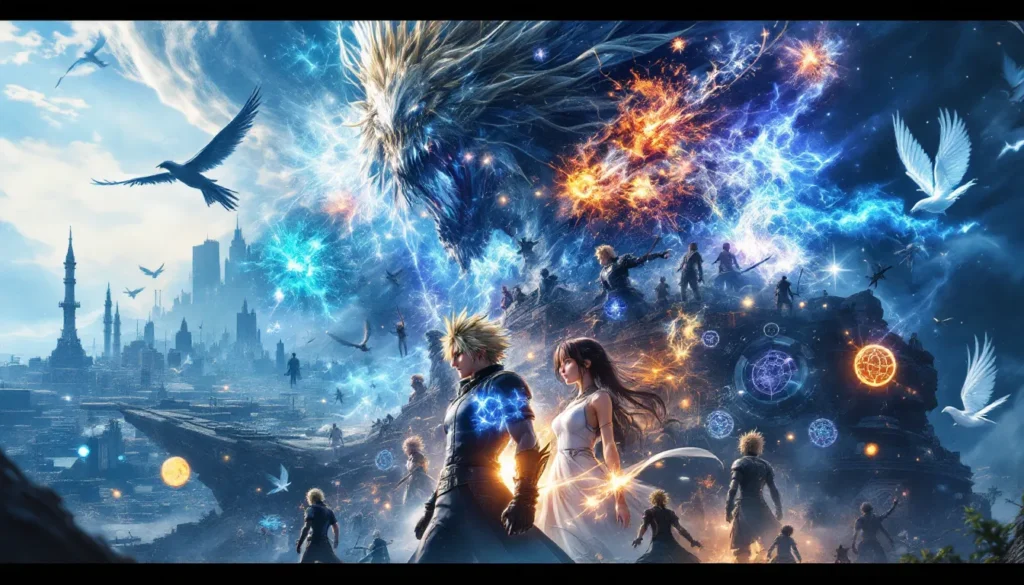
Final Fantasy stands as one of gaming’s most enduring and beloved franchises, spanning nearly four decades and multiple genres. Since its debut in 1987, the series has defined what JRPGs can be, weaving complex narratives, unforgettable characters, and innovative combat systems into worlds that players return to again and again. Whether you’re a veteran who’s been with the series since the NES days or a newcomer curious about jumping in, the world of Final Fantasy offers something for everyone. This guide walks you through the franchise’s evolution, its most essential games, recurring themes that tie it all together, and where to start your own journey through these epic worlds.
Table of Contents
ToggleKey Takeaways
- The world of Final Fantasy has evolved from a 1987 NES financial gamble into a multimedia empire, with each numbered entry pushed gaming boundaries through innovative mechanics, compelling narratives, and emotional depth.
- Modern entry points like FFXVI (action combat), FFX (turn-based strategy), and FFXIV (MMORPG storytelling) cater to different gaming preferences, making the franchise accessible regardless of play style or platform.
- FFXIV stands as the franchise’s current flagship, proving MMO narratives can rival single-player experiences through consistent expansions, positive community culture, and story-driven content that respects player investment.
- The world of Final Fantasy doesn’t require sequential play—each game is self-contained with its own world, yet recurring elements like Chocobos, Summons, and character archetypes create thematic continuity across entries.
- Upcoming remakes including FFVIII and continued FFVII Rebirth development signal Square Enix’s commitment to reimagining classics while encouraging developer experimentation rather than strict faithfulness to originals.
- Communities across Reddit, Discord, and official forums make the Final Fantasy experience collaborative, with veterans actively supporting newcomers and fostering one of gaming’s most welcoming fanbases.
The Evolution of Final Fantasy: From 1987 to Modern Day
The Classic Era and Industry Impact
The original Final Fantasy dropped on the NES in 1987 when the JRPG genre barely existed. Square was on the brink of bankruptcy, and this title was meant to be a financial Hail Mary, hence the name. It worked. The game’s success didn’t just save the company: it fundamentally shaped what role-playing games could be on consoles.
Throughout the late ’80s and ’90s, each numbered entry pushed boundaries. FFIV introduced a more cinematic approach with character-driven storytelling. FFVI refined that formula while delivering one of gaming’s greatest villains in Kefka. FFVII became a cultural phenomenon in 1997, establishing the template for blockbuster JRPGs that’s still studied today. These classics defined the franchise’s core identity: emotional depth, world-ending stakes, and combat that demanded strategy.
The PS1 era saw Final Fantasy become a household name outside Japan. FFX revolutionized the series with voice acting and a more emotional narrative focus. By the early 2000s, the franchise had secured its place as gaming royalty.
The Modern Renaissance and Latest Releases
The 2010s and 2020s brought a reinvention. FFXIV launched weakly in 2010 but experienced an unprecedented resurrection with “A Realm Reborn” in 2013, becoming gaming’s most successful MMORPG. Simultaneously, FFVII Remake shattered expectations in 2020 with real-time combat and a modern narrative reimagining that honored the original while daring to subvert expectations.
Final Fantasy XVI, released in June 2023 exclusively for PS5, marked another evolution. It stripped away traditional turn-based combat for full real-time action, repositioning the series alongside modern action RPGs. The game’s Dominants system, warriors channeling primal powers, delivered some of the franchise’s most cinematic battles. Its success proved Final Fantasy remains willing to evolve while maintaining its identity.
As of 2026, the franchise is at a fascinating crossroads. FFXIV continues to dominate the MMORPG space with its Endwalker expansion and subsequent patches. FFVII Rebirth (PS5 exclusive) launched in early 2024 and continued the Remake saga’s momentum. Meanwhile, Square Enix announced FFVIII Remake is in development, signaling their commitment to revisiting and reimagining classic entries for a new generation.
Core Games and Numbered Entries Worth Playing
Fan Favorites: FFVII, FFX, and FFXIV
FFVII remains the gold standard. Cloud Strife’s quest to stop Sephiroth became the template for epic JRPG storytelling. The game’s materia system offered incredible depth in character customization, letting players experiment with nearly infinite builds. If you haven’t played it, the original is still excellent on modern platforms (PC, PS4/PS5, Switch, mobile). The Remake trilogy is reshaping how we understand this world, and fans debate its changes with passionate intensity.
FFX perfected emotional narrative. Tidus and Yuna’s story hit differently, the relationship feels genuine, the world’s destruction feels urgent, and the ending still hits hard decades later. The sphere grid system rewarded grinding without feeling tedious. It’s available on PS2, PS3, PS4, PS5, and Switch, making it accessible.
FFXIV deserves its own section below, but mention it here because it’s arguably the franchise’s current flagship. The MMORPG has millions of active players across all major platforms (PC, PS4, PS5, Mac). Its storyline rivals single-player entries, this is crucial. Many people assume MMO stories are filler: FFXIV’s prove otherwise.
Hidden Gems and Underrated Titles
FFIV often gets overshadowed, but it’s essential. The job system was revolutionary, and the emotional beats, particularly the sacrifice at the Mt. Ordeals, remain powerful. It’s easily accessible on modern platforms.
FFVI features some of the best environmental storytelling in gaming. The World of Ruin sequence fundamentally shifts the game’s tone and scope. The ensemble cast means no single protagonist dominates: everyone matters.
FFIX is criminally underrated. It’s a love letter to the series’ roots, featuring Zidane, one of gaming’s most charming protagonists. The game looks dated, but the writing is phenomenal. Even though being a PS1 title, it holds up because the character arcs are genuinely strong.
FFXII introduced the gambit system, a proto-AI that let you program character behavior. It was experimental and polarizing, but fans who understood it loved it. The Zodiac Age (PS4, Xbox One, Switch) modernized it beautifully, and most players now appreciate what it attempted.
Each of these titles offers something distinct. The franchise’s strength isn’t that every entry is perfect, it’s that nearly every entry did something interesting and different.
Final Fantasy’s Interconnected Universe and Recurring Themes
Characters, Summons, and Iconic Lore Elements
Final Fantasy games don’t exist in a single universe, each numbered entry occupies its own world. But, certain elements recur so consistently that they form a thematic throughline. The Chocobo, a rideable bird-creature, appears in nearly every game. Summons, powerful entities the player invokes in battle, are series staples. Bahamut, the divine dragon, shows up across multiple worlds. Ifrit and Shiva represent destructive fire and ice forces.
Character archetypes repeat too. The stoic swordsman (Cloud, Squall, Noctis). The quirky black mage (Vivi, Quina). The healer-sage. This isn’t lazy design, it’s intentional. These archetypes let new players feel grounded while veterans appreciate the variations.
The recurring visuals matter. Moogles. Tonberries. Cids (a character named Cid appears in nearly every game). These aren’t canon connections: they’re spiritual throughlines. They create a sense of continuity that lets players feel they’re entering a larger multiverse of Final Fantasy worlds.
World-Building and Environmental Storytelling
Final Fantasy games excel at making worlds feel lived-in. FFX’s Spira is shaped by Cenotaph towers, monuments to pilgrims’ journeys. The world’s architecture reflects its religious devotion to Sin. Walking through settlements tells the story without exposition dumps.
FFXIV takes this further. The sprawling cities of Limsa Lominsa, Gridania, and Ul’dah feel authentically different, economically, culturally, politically. Every environmental detail serves narrative purpose. The Scions’ base reflects their growing influence and resources as you progress.
FFVII’s Midgar is the franchise’s best city-building achievement. The industrial sprawl reflects Shinra’s dominance. The slums contrast with the gleaming corporate center. Seeing Midgar’s destruction in the Remake feels devastating because you’ve inhabited that space.
Weather, music, and NPC dialogue combine to create atmosphere. Players don’t just absorb lore, they inhabit these worlds. That environmental immersion is core to why Final Fantasy resonates so deeply.
Spin-Offs, Side Stories, and Expanded Universe Content
Crisis Core, Kingdom Hearts Collaborations, and Compilation of Final Fantasy VII
Square Enix realized the FFVII universe was too rich to confine to one game. The Compilation of FFVII expanded the world significantly. Dirge of Cerberus (a third-person shooter) followed Vincent post-FFVII. Advent Children (2005 film) continued the story cinematically. None of these achieved FFVII’s impact, but they deepened the lore.
Crisis Core: Final Fantasy VII Reunion (released December 2022 for all major platforms) was the breakthrough. As Zack Fair, players experienced FFVII’s backstory with modern visuals and refined combat. The emotional weight, knowing Zack’s fate, made the experience hit harder. Many players who’d finished FFVII Remake immediately jumped into Crisis Core Reunion.
Kingdom Hearts represents the franchise’s most unexpected collaboration. Disney and Final Fantasy characters share screen time in Tetsuya Nomura’s fever dream of a narrative. It’s absurd, it’s charming, and it works. Final Fantasy characters like Cloud, Tifa, and Yuffie gained new dimensions through these crossovers. Kingdom Hearts demonstrated Final Fantasy’s cultural reach and willingness to experiment.
Mobile Games and Accessible Entry Points
Final Fantasy: Brave Exvius and Final Fantasy: Record Keeper proved mobile JRPGs could be substantial, story-rich experiences. FFVII: The First Soldier attempted a battle royale tie-in (though it shut down in 2023). Final Fantasy XIV Mobile is in development as a simplified MMORPG experience.
Mobile’s democratized entry points matter. Dissidia Final Fantasy Opera Omnia brought iconic characters together for turn-based combat accessible on phones. While these games monetize aggressively, they’ve introduced millions to Final Fantasy who might not own consoles.
Final Fantasy XV: Pocket Edition brought the full (if simplified) FFXV story to mobile with stunning art direction. These spin-offs and mobile games aren’t second-class citizens, they’ve kept the franchise visible between major releases and created genuine communities.
Final Fantasy XIV: The MMORPG That Changed Everything
Community, Expansions, and Endgame Content
FFXIV deserves deep focus because it’s arguably the franchise’s current apex. Launched in 2010 to scathing reviews, A Realm Reborn (2013 relaunch) salvaged it through developer Yoshi-P’s vision. That gamble became gaming’s greatest redemption arc.
The game’s expansions have been consistently excellent. Heavensward (2015) introduced flying and refined the job system. Stormblood (2017) expanded the world and delivered political intrigue. Shadowbringers (2019) is considered the franchise’s narrative peak, its main scenario questline rivals single-player entries in emotional depth. Endwalker (2021) concluded a 10-year narrative arc in a way that satisfied millions of invested players.
Endgame content includes Savage Raids (challenging 8-player dungeons requiring coordination), Ultimate Raids (brutal difficulty for hardcore players), and Mythic+ Dungeons (scalable difficulty). Casual players raid too, Normal Raid difficulty remains accessible while still requiring mechanics knowledge.
The community is FFXIV’s greatest asset. While all online games have toxic players, FFXIV’s culture actively discourages it. Veterans help sprouts (new players, identifiable by their sprout icons). Party chat is generally positive. This isn’t accidental, it’s cultivated through design decisions and GM enforcement.
Why FFXIV Stands Apart from Other MMOs
FFXIV prioritizes story. You don’t skip cutscenes: many guilds watch them together. The narrative isn’t side content, it’s central. Compare this to most MMOs where story is an afterthought.
Job design is exceptionally deep. Tanks, healers, and DPS all feel distinct with legitimate role identity. The role-playing aspect isn’t just flavor: it shapes how you engage moment-to-moment. Multiple jobs per character mean players can experience the same content through different lenses.
Patch cycles are consistent. Major patches arrive roughly every 3-4 months. Content creators know when to expect updates. Square Enix’s transparency about upcoming features creates sustainable hype rather than surprise drops that fracture the playerbase.
Bridge content matters. If you’re not raiding endgame, there’s treasure hunting, crafting guilds, PvP (though it’s not the focus), housing systems, and Gold Saucer gambling. The game respects your time whether you’re hardcore or casual.
FFXIV runs on PC, PS4, PS5, and Mac. Console versions prove MMOs don’t need to compromise on console experiences. The controller UI is intuitive, and performance is solid. Cross-platform play lets friends on different systems play together seamlessly.
The Future of Final Fantasy: What’s Coming Next
Upcoming Releases and Square Enix’s Vision
FFVII Rebirth launched in February 2024 and continued the Remake saga’s narrative ambition. The next chapter promises to conclude the Remake trilogy’s story, though Square Enix has hinted more content beyond that remains possible. The commercial success and critical reception ensure the Remake saga will define FFVII’s cultural moment for years.
FFVIII Remake was announced in development in 2023. Given the success of FFVII Remake, fans are eager to see how Squall and Rinoa’s story gets reimagined. The original’s complex time-travel narrative and junction system offer interesting modernization opportunities. Expect this to be years away, but it’s confirmed.
FFXVI received positive reception post-launch, and Square Enix committed to a DLC roadmap. The action-heavy combat direction divided players but proved the franchise could evolve without alienating core audiences. Future entries will likely take cues from FFXVI’s real-time direction while potentially reintroducing strategic depth.
FFXIV continues its expansion roadmap. “Dawntrail” launched in July 2023 and introduced new jobs and storylines. Patch 7.0 and beyond have been outlined through 2027. Yoshi-P has indicated even after Endwalker’s conclusion, new regional storylines will continue FFXIV’s momentum.
Square Enix is clearly betting on the franchise’s adaptability. Rather than retreating to formula, leadership is encouraging developers to take risks. This manifests in FFXVI’s action pivot and FFVII Remake’s narrative subversions. The strategy seems to be: honor legacy while creating new entries distinct enough to stand alone.
Fan Expectations and the Evolution of the Franchise
Fans want several things simultaneously: innovation and tradition, accessibility and depth, single-player and multiplayer experiences. The franchise is attempting to satisfy all these demands by letting individual entries specialize rather than making each game “for everyone.”
The Remake series proves fans care less about faithfulness than quality. FFVII Remake changes plot points, adds new characters, and expands lore, yet it’s beloved because it respects the source material’s spirit while daring to subvert expectations. This gives Square Enix permission to reimagine older entries without needing to remake them 1:1.
Community engagement shapes development. FFXIV’s transparency about player feedback has become the gold standard. When players suggest balance changes or content needs, Yoshi-P often explains why those suggestions can or can’t work. This transparency builds trust.
The franchise’s next decade likely involves: continued Remake project expansion, FFXVI receiving more substantial DLC, FFXIV’s steady evolution, and experimental spin-offs testing new concepts. Rather than chasing trends, Square Enix seems committed to letting each entry define what Final Fantasy can be in its particular moment.
How to Get Started in the Final Fantasy Universe
Choosing Your First Game Based on Your Gaming Style
If you want modern action combat and a self-contained story, FFXVI (PS5 exclusive) is the entry point. It demands no series knowledge and delivers a complete narrative in one game. Combat feels like Devil May Cry meets traditional JRPG pacing. Expect 40-50 hours for a first playthrough.
If you prefer turn-based strategy with emotional storytelling, FFX (available on most platforms) remains unmatched. The sphere grid lets you customize character progression. The story is genuine, not overwrought, and accessible regardless of age. It’s a solid 50+ hour investment.
If you’re willing to commit to a living world with community, FFXIV (PC, PS4, PS5, Mac) offers unmatched value. The free trial lets you play through A Realm Reborn’s complete story and first expansion (Heavensward) without time limits. Only when purchasing expansions does it become paid. Expect 100+ hours before experiencing Endwalker.
If you want the franchise’s best-regarded narrative (with some caveats about pacing), FFVII Remake (PS4, PS5, upcoming on PC) is excellent, though it’s designed as the first of a trilogy. Starting here means committing to multiple games, but the payoff is worthwhile.
If you love JRPGs but want something underrated, FFIV or FFVI via emulation or legitimate ports offer the classic experience that defined the genre. Both are completable in 30-40 hours and introduce foundational Final Fantasy concepts.
Building Your Final Fantasy Journey
A sustainable approach involves breadth before depth. Start with one modern entry, likely FFXVI, FFX, or FFXIV based on your preferences. Complete it. This teaches you the franchise’s language: how it handles storytelling, pacing, and character development.
Once comfortable, explore a classic entry. Final Fantasy 1 on NES (available on Switch, mobile, and emulation) takes 15-20 hours and is surprisingly playable even though age. FFIV via mobile ports or emulation offers more substantial story in 30 hours. These create context for how the franchise evolved.
Final Fantasy games are not interconnected, each is self-contained, so playing order doesn’t matter narratively. Play chronologically, by release date, or by interest. The only exception: if doing FFVII Remake, play Crisis Core Reunion first to understand Zack’s significance.
Don’t feel obligated to complete every entry. Try each game for 5-10 hours. If it clicks, continue. If it doesn’t, move on. The franchise’s strength is variety: something will resonate with you. The world of final fantasy is broad enough to accommodate any gaming preference.
For guides, tier lists, and character deep-dives, Final Fantasy Dragon: Unveiling resources and Zidane Final Fantasy: Unraveling character analysis provide specific mechanical advice. If you’re interested in the narrative reimagining, Final Fantasy Characters in Kingdom Hearts: Unforgettable Crossovers shows how these worlds intersect unexpectedly.
Recent announcements from gaming outlets like Gematsu and RPG Site keep you updated on upcoming releases and balance patches. Japanese gaming coverage via Siliconera provides early news about franchise developments.
Join communities, Reddit’s r/FinalFantasy, FFXIV’s official forums, or Discord servers dedicated to specific games. The franchise’s best aspect is its people. Veterans love explaining lore. New players asking questions get genuine, helpful responses. The Final Fantasy community remains one of gaming’s most welcoming.
Conclusion
The world of Final Fantasy has evolved from a desperate gamble into a multimedia empire spanning gaming, film, music, and merchandise. Yet even though its scale, it never lost what made it special: the ability to make players feel. Whether through Aerith’s sacrifice, Tidus’s final conversation with Yuna, or the emotional payoff of FFXIV’s Endwalker conclusion, Final Fantasy games craft moments that stick with you.
What makes this franchise remarkable isn’t that every entry is perfect. It’s that each entry dares to be different while maintaining core identity. FFVII Remake reinvents while respecting legacy. FFXVI embraces action combat unapologetically. FFXIV proves MMO storytelling can rival single-player experiences. Upcoming remakes suggest Square Enix trusts developers to reimagine rather than replicate.
For players jumping in now in 2026, the timing is excellent. Modern ports mean every significant entry is accessible on your preferred platform. The franchise isn’t gatekeeping knowledge, each game tells a complete story. Communities are active and welcoming. Whether you’re seeking a 30-hour emotional journey, a 100+ hour multiplayer adventure, or something in between, Final Fantasy has you covered.
Start somewhere. Try one game. If it resonates, explore further. The world of Final Fantasy is vast, but it’s built around a simple promise: memorable characters, compelling stories, and worlds worth inhabiting. Four decades in, that promise still holds.